

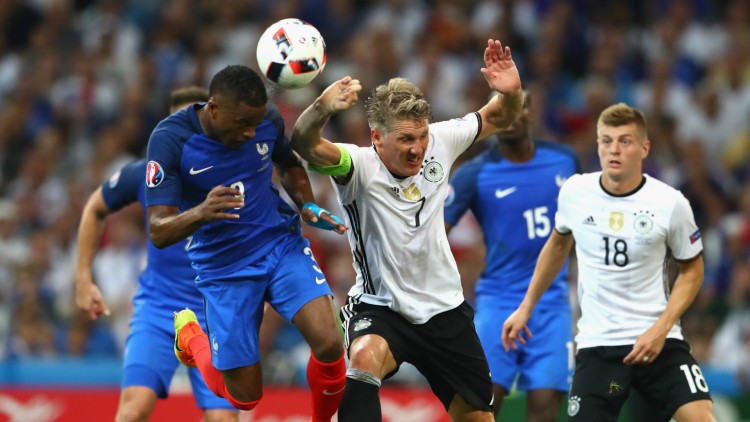
After successfully traversing the often testing nature of the tournament group-stages with largely flying colours once again this year, Joachim Low and his impressive German outfit seemingly singled themselves out as strong favourites to really go all the way at Euro 2016.
The first of their hopeful opponents among the knock-out stages of the competition, the less than formidable footballing nation of Slovakia, hardly provided the Germans with much of a fight within the grand scheme of things. The likes of Jerome Boateng, Mario Gomez and Julian Draxler finished off a no-nonsense 3-0 victory for Joachim Low’s side, sincerely casting England’s ill-fated attempts of beating the Slovakians among Group B in a truly damning light.
Although Italy would certainly provide Germany with a much sterner test looking forward to the quarter-finals, that too was a fixture that ultimately culminated in German success. Die Mannschaft were indeed taken all the way to penalties by the Azzurri in a match that really could have gone either way, but after a string of poor misses from either side of the goal-mouth, Germany eventually saw themselves through to the semi-finals in the end.
Yet as tournament hosts France clearly intended to offer the Germans are far more robust attacking outfit to deal with last time out at Euro 2016, Didier Deschamps’ proud French outfit somehow proved too much for the supposedly formidable Germans when push truly came to shove. Germany looked distinctly toothless inside the final third for one reason or another, which seemingly led to Joachim Low’s impressive world champions being cast aside from the competition in largely unceremonious circumstances.
Really enjoyed that. Germany'a build-up play was so good but Muller looked really out of sorts. Poor movement and clumsy with the ball.
— Michael Cox (@Zonal_Marking) 7 July 2016
With Thomas Müller having a poor competition, Germany have actually missed Mario Gomez. This game would have suited him. Surely.
— Asif. (@HerreraTekkers) 7 July 2016
So just where did the Germans go wrong this summer then? Despite the overriding sense of complexity and depth that usually surrounds national outfits among widely watched international tournaments, Germany arguably fell just short of delivering the goods on the back of one simple notion alone – they didn’t possess enough fire-power up-top right when they really needed it.
Although 2014 will seemingly forever go down as a truly wonderful international campaign for the Germans involved in the World Cup in Brazil, it was also a time in which Germany clearly needed to buck their future ideas up with a selection of their most recognisable international stars calling an abrupt end to their glistening careers with the national team.
Bayern Munich’s Phillip Lahm certainly proved a big miss for the Germans among Euro 2016 due to his impressive leadership qualities and sheer composure on the ball proving particularly difficult to replace, yet Miroslav Klose’s notable absence from the national team setup arguably proved a great deal more telling in the end.
Whilst the entire team managed to retain possession inside the opposition’s half far better than any of their counterparts upon the international scene this summer, Joachim Low’s side were nonetheless rather ineffective in front of goal for large portions of the competition. The team looked somewhat void of attacking intent with the small figure of Mario Gotze leading the front-line, especially as Bayern Munich’s Thomas Muller somehow registered a tournament to forget this time around.
The team looked vastly improved with Mario Gomez stepping in to fill the void left by Miroslav Klose of course, but once the former Bundesliga favourite ultimately fell victim to a late and frustrating injury against the Italians in the semi-final, Germany clearly found themselves with an uphill battle to climb when it came to scoring goals.
Although both Max Kruse and Stefan Kiessling – of Wolfsburg and Bayer Leverkusen respectively – seemingly saw each of their names cast aside for a number of combining factors from both on and off the field, Joachim Low should have simply worked harder to secure more attacking options ahead of Euro 2016 itself, for it is for this reason alone that Germany ultimately failed to capture the same kind of brilliance that made them seem almost unplayable back in 2014.

Harry Burford
Latest posts by Harry Burford (see all)
- Is there any way back for Dimitri Payet at West Ham United? - January 16, 2017
- Everton fans rejoice as a new star is born at Goodison Park… - January 16, 2017
- Must Man City fans show patience in their current main man at the helm? - January 16, 2017
- Could this emerging Spurs favourite really be heading for Real Madrid? - January 12, 2017


Follow us